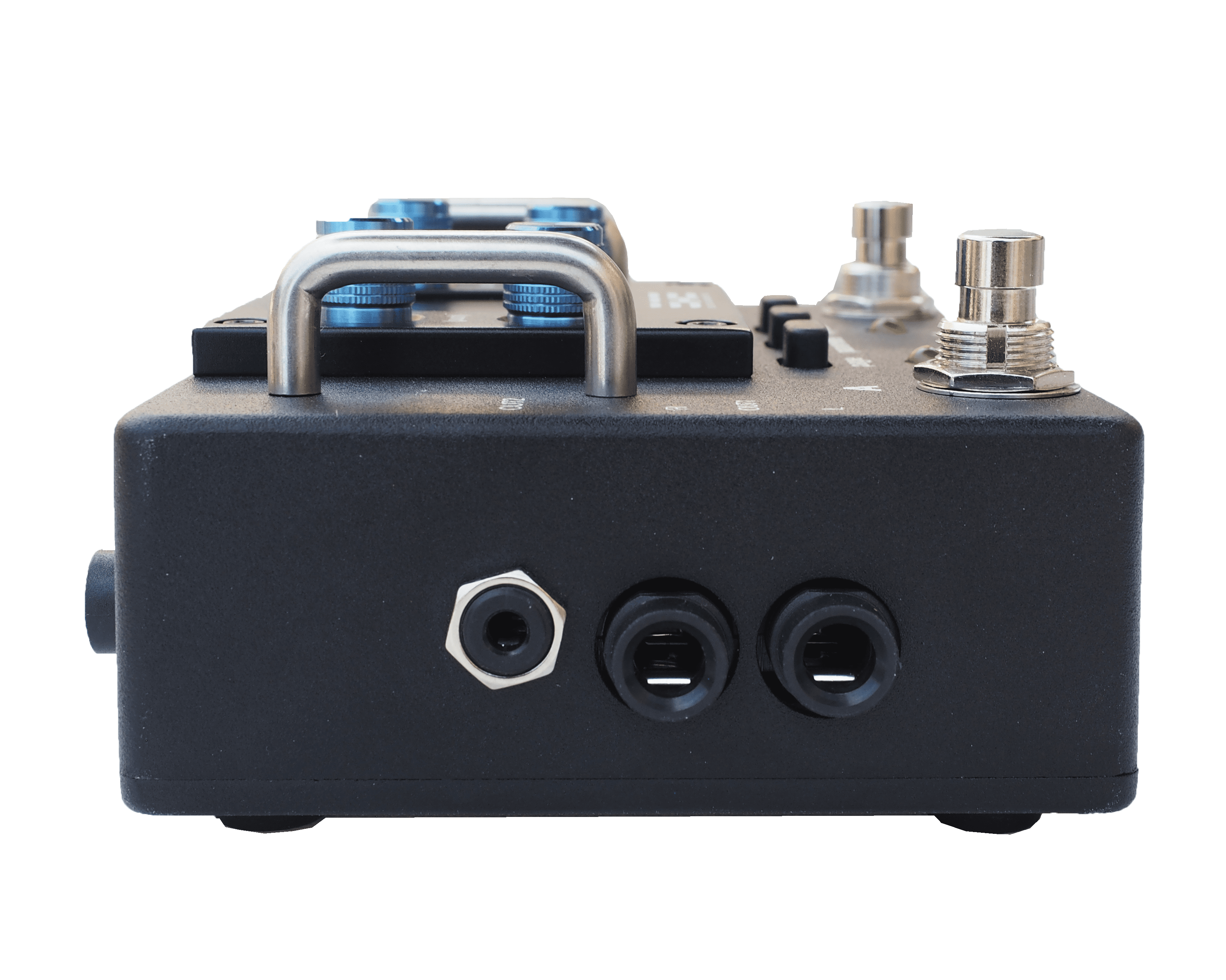
Elite Acoustics hat den Stompmix 4 veröffentlicht: 4-Kanal Digitalmixer mit integrierter DSP-Power, Batteriebetrieb und im super kompakten Stompbox-Format
The Meris Polymoon is the 3rd pedal release from the SoCal based pedal builder, following on the heels of their other two recent offerings, the Ottobit Jr. and Mercury7 Reverb. Meris’ previous pedals were based on their 500 series rack modules, but the Polymoon is their first all-new offering in a dual foot-switch pedal format. While the Polymoon can generally be classified as a delay pedal or modulated delay, this general categorization doesn’t do justice to the myriad possibilities contained within the Polymoon’s unassuming little white enclosure.
The Polymoon was initially inspired by the concept of chaining together rack delay effects to create all-new sounds, a practice utilized in the 80’s by guitarists including Allan Holdsworth and Frank Zappa. Before the Polymoon, the notion of chaining together a series of ultra-high quality stereo effects algorithms was usually limited to either using rack gear, some very expensive multi-effects processors, or a series of high-end guitar pedals. The concept is rare in a pedal as it is, and the Polymoon is one the most advanced attempts at a delay this sprawling and complex.
While companies have said it before in various marketing copy about their products, the Polymoon really is like several pedals in one because it offers such a wide range of parameter options across a series of different effects. Put very simply, the signal flow of the Polymoon goes something like this: Input → Dual Dynamic Flangers in Parallel → 6 Delays in Series (with Early Modulation and Late Modulation options) → Dual Barberpole Phasers in Parallel → Filter → Output. While you could reduce the Polymoon to just a dry single-tap delay, this pedal is all about the journey to the dark side of the moon and beyond.
Here’s a rundown of the Polymoon’s features before we dig in.
The Meris Polymoon is truly a one-of-a-kind pedal and a masterpiece of original delay design that harbors an incredibly diverse range of modulated delay sounds. Despite the pedal’s complex signal flow, it offers an intuitive surface interface that immediately yields inspiring results. As you delve below the surface, even more boundless possibilities are revealed. Alt knob functions expand the sound palette immensely, and the MIDI implementation, forgiven of a couple unorthodoxies, pushes the Polymoon’s versatility well beyond many pedals from rival builders. With delay sounds ranging from clear single taps to heavily diffused multi-tap delay ambience with filtering, flanging, phasing, and other modulation options, the Polymoon is a journey unto itself and is one of the most rewarding sources of new sounds guitarists are likely to find in a dual foot-switch stompbox. In other words the Polymoon is a must-try for delay lovers and arguably the most stellar offering from Meris to date.
That concludes our Meris Polymoon review. Thanks for reading.
The post Meris Polymoon Review appeared first on Best Guitar Effects - Reviews of the Best Guitar Pedals & Gear.
from Best Guitar Effects – Reviews of the Best Guitar Pedals & Gear http://ift.tt/2D1KWKA http://ift.tt/2DtqlQv
via IFTTT
"Translucent Drive Manipulator Westwood
is a touch sensitive translucent overdrive manipulator as clean and
pure as the breeze which blows through a grove of Douglas Fir trees, and
as hot as a damn fine cup of coffee. This mild-mannered light- to
medium-gain overdrive with active EQ controls will still knock the
socks right off your trusty low-wattage combo amp, pushing it into
anything from cutting, edge-of-breakup rhythm tones, all the way to
articulate, singing lead tones stacked high with pleasing even-order
harmonics and sweet, sweet sustain. And if you pair it up with your
favorite head and cab, you should probably call the neighbors first,
because the Westwood’s Level control has enough output on tap to alert
the proper authorities. Even the FBI. Each and every Westwood is a
real Blue Rose case, hand built by a team of special agents in the
Black Lodge of Akron, Ohio, USA, where the owls are not what they seem,
there’s always music in the air, and the birds sing a pretty song."
NEW PEDALS! http://www.stompbox.de/ We haven’t been lazy lately... Besides working on the backordered Diablo GH signature pedals, we came up with no less than 4 pedals... a very special one:
MOTÖRBASS
rock’n’roll bass distortion
...and the start of a whole new series of pedals – the BLACK BOX series. A range of pedals with uniform appearance (black textured enclosure, stainless steel plates) – easy to use, compact and full of great tones. We start with these 3, there will be more...
KING KRUNCH
cranked vintage amp sounds,
from clean to full roar
RECTOPLEXXX
plexi bite and recto punch...
tight riffmachine
POWER EQ
musical tone tool and
flexible clean boost
Poly Expressive is a foot controller that is easy to configure to do exactly what you want. Want something that switches between 20 presets with clear labels? Easy. Want much more including X Y pads and pressure sensitive controls? It does that too, and it’s all easy to set up with our setup app. Simply print your board from the app and slide it into the sleeve. Easy control of pedals from Chase Bliss, Eventide, Pigtronix, Strymon and more, amps from Kemper, Positive Grid, Peavey and Hughes & Kettner as well as full featured control of Ableton and Bitwig, all without taking your hands off your instrument. Poly uses top quality components like Switchcraft jacks and lets you express more with your feet.
Poly Expressive Features
Detects position and pressure
Can send 3 dimensions at once per area, multiple MIDI messages can be mapped to each dimension.
Made from Polycarbonate, the same material as riot shields. It’s tough.
No hard limit on how many messages per area.
Two sizes: Large Fits A3 or ledger paper, mini is A4 or US Letter
Great for controlling pedals, amps, DAWs/software and mobile apps
Can send MIDI clock
Daisy chain multiple Poly wirelessly
Premium parts including Switchcraft connectors
Built in Melbourne, Australia
Bluetooth and wired MIDI
Standard 9V 100mA centre negative power required
Can send MIDI control change (CC), program change, note on/off, aftertouch, pitch bend.
6.5 MHz sample clock for low latency and accurate position sensing.
⅛” / 3 mm thick
As many regions as you want, in any colour.
Whole area: 22.2" x 13.8" / 565 mm X 350 mm,
active window area 18.5" x 11.6" / 469 mm X 294 mm.
Setup app runs on iOS, Android, Mac, Windows and Linux.
Poly Expressive is on Kickstarter and with just a few days to go is almost funded. Prices for a full unit start from $229 USD.
If this novel approach to controllers for your pedals and/or software instruments tickles your fancy it would be worth checking out the Kickstarter page here soon: http://ift.tt/2AzO2Ii
from AskAudio Magazine http://ift.tt/2lS0EAK http://ift.tt/2lRqkxi
via IFTTT
Dass die NuTube Technologie nicht nur auf die Hitze und die hohe Stromaufnahme einer „echten“ Röhre verzichten kann, zeigt sich daran, dass der Ibanez Nu Tube Screamer, wie seine mit Dioden bestückten Kollegen,nach wie vor auch mit einer 9-Volt-Batterie betrieben wird. Neben den üblichen Reglern für Drive, Level und Tone hat der neue Ibanez Nu Tube Screamer ein Blend-Poti spendiert bekommen. Hier kann also zwischen dem Original- und dem Effektsignal offensichtlich noch mal eine Spur feiner dosiert werden.
Ganz billig ist der neue Zerrer allerdings nicht, Ibanez lässt sich für den Nu Tube Screamer knapp 270,- Euro bezahlen.
Preis
Ladenpreis: ca. 266,- Euro
from AMAZONA.de http://ift.tt/2lLI7G5 http://ift.tt/2CzrnMU
via IFTTT
Trotz der geringen Größe wurden einige Bedienelemente auf der Oberseite platziert. Neben drei kleinen Potis, die für die Effekttiefe (Depth), den Effektlevel (Level) und das Frequenzspektrum des Flanger-Effekts (Width) zuständig sind, wurde ein großes Rate-Poti installiert, das mittig thront und sich für die Effektgeschwindigkeit verantwortlich zeigt.
Die darunter installierte Betriebsleuchte hat gleichzeitig die Funktion eines Tasters, mit dem die beiden Flanger-Modi abgerufen werden können. Für den sogenannten H.Flanger leuchtet die Lampe blau, bei rotem Licht ist der B. Flanger aktiviert. Last, but not least lässt sich natürlich auch dieses Bodenpedal mit einem Fußschalter aktivieren, der bei gedrücktem Zustand noch eine Flanger-Spezial-Funktion an Bord hat, die wir natürlich gleich im Praxisteil noch genauer beleuchten wollen. Auch unser heutiger Proband arbeitet übrigens, wie viele seiner Mitbewerber auf dem Markt, mit einer True-Bypass-Schaltung.
Auf der Bedienoberfläche finden sich drei Minipotis, ein großes Drehpoti, ein Taster mit Mehrfarb-LED und der Fußschalter.Geregelt werden Effekttiefe (Depth), Effektlevel (Level), das Frequenzspektrum des Flanger-Effekts (Width) und Rate (Effektgeschwindigkeit).Aktiviert wird das Bodenpedal über den stabilen Fußschalter, der noch über eine Feedback Ramp Control Funktion verfügt.
from Aktuelle Themen von bonedo.de http://ift.tt/2lw0sHI http://ift.tt/2lAI3sB
via IFTTT
In the spirit of full disclosure, I am morally obligated to be honest and say that not only do I LOVE Chase Bliss Audio’s work, I like everyone on the Chase Bliss team on a personal level. You’re free to call bias, but let’s be real: we’re all CBA fan-folk. You can’t love guitar pedals and not be. From the very first Warped Vinyl to today’s Warped Vinyl HiFi, everything Joel and the rest of the Chase Bliss team altruistically toils away to serve the undeserving worms that we are is almost guaranteed to blow us away. And some of us will even take a break from the “will I/won’t I” nail-biting and pull the trigger on tossing a portion (or the sum) of our savings into a Tonal Recall or Brothers, consequences be damned.
Earlier in December 2017, CBA made it even more difficult to remain frugal. In a totally unexpected announcement, Joel & Co. put the world on notice: the third (and likely ultimate) Warped Vinyl pedal was to be released with “HiFi” attached to the moniker. In the face of this news I was, like my gear nerd brethren everywhere, floored, then inquisitive as to why Chase Bliss chose to reissue the pedal a third time. Of course I made plans to get one of these in my hands by any means necessary.
We’ve reviewed both the Warped Vinyl and Warped Vinyl MKII, so to avoid beating a dead horse, I plan to focus on what has changed in the Warped Vinyl HiFi in this review rather than expounding in great detail the features that have always been there. I will say before we get started: this is more than just an alternate skin.
....
You can see the Hold switch in action in Chase Bliss’s demo featuring Zack Warpinski here:
The Chase Bliss Audio Warped Vinyl HiFi is a serene work of beauty that offers unparalleled audio fidelity and tonal options in a compact all-analog chorus/vibrato pedal. To put it in musical parlance, the HiFi is not Chase Bliss experiencing a case of megalomania; it’s more a thematic variation, a reharmonization of a prevailing melody. With the addition of the Hold switch and Lag knob, the Warped Vinyl HiFi adds a new element of control and flexibility that was missing from the classic formula, and the added bonus of that cleaner signal path should convince any past doubters who weren’t feeling the lo-fi vibe. Is it good enough to be the LAST Warped Vinyl? That’s not my call to make, and I’d never presume to assume that that’s the case. All I know is that the updates are significant enough to differentiate the HiFi from its forebears, and in my opinion, forward-thinking enough to justify discontinuing the MKII with no regrets. You can still accomplish most of the tones that the last two models could, but now you don’t need to relinquish signal clarity. So for all we know, it may not be the last Warped Vinyl, but it’s definitely the cleanest and most refined to date. At any rate, it’s the best analog chorus/vibrato pedal of it’s kind in my book.
That concludes our review of the Warped Vinyl HiFi by Chase Bliss Audio. Thanks for reading!
The post Chase Bliss Audio Warped Vinyl HiFi Review appeared first on Best Guitar Effects - Reviews of the Best Guitar Pedals & Gear.
from Best Guitar Effects – Reviews of the Best Guitar Pedals & Gear http://ift.tt/2lnt3yW http://ift.tt/2lvjo8H
via IFTTT
Ohne gemein klingen zu wollen, aber aus China erwarte ich nur sehr selten etwas Eigenständiges, vor allem von Firmen, die bisher durch Kopien aufgefallen sind. Aber dennoch passiert es mal: Biyang hat LiveMaster vorgestellt – eine Multieffekteinheit, die mit analogen Modulen bestückt werden kann.
LiveMaster
Plug‘n‘Play heißt die Devise: Ihr holt euch einen Rahmen mit 4, 7 oder 10 Effektslots und steckt anschließend die sog. Modular-Effekte rein. Diese beinhalten jeweils wohlbekannte Schaltkreise von Effekten und nützliche Helfer. Aktuell sind folgende vorhanden:
Delay (Lila)
Delay (Blau)
Chorus
Tremolo
Flanger
Crunch
Fuzz
Guv‘nor
Distortion (rot)
Distortion (orange)
Overdrive (grün)
Overdrive (weiß)
Compressor
Boost
Big Fuzz
Phase
Preamp
Metal End
Delay / Reverb
Tuner
Loop
Amp Switch
Wenn man sich die Bilder der kleinen Module ansieht, wird schnell klar, wer hier das große Vorbild war. Wo wir wieder bei den Kopien wären. Allerdings ist das nicht ganz fair, denn im ganzen Effektsegment wird fröhlich vom anderen kopiert. Aktuell sind 22 Module vorhanden, es sollen aber mit der Zeit satte 40 Stück werden.
Nachteil ist sicher, dass man immer an die Module gebunden sein wird. Vorteil: Man hat ein roadtaugliches Multieffekt, das ohne Kabel auskommt und quasi sofort einsatzbereit ist.
Man schaltet allerdings in keiner der drei Gehäuseversionen Effekte einzeln an und aus, sondern hat 3, 5 oder 7 Fußschalter, die voreingestellte Effektketten einschalten, ähnlich wie bei digitalen Multieffekten. Einer der Fußschalter ist für die Bank zuständig, es kann zwischen Rot und Blau gewechselt werden.
Preis und Verfügbarkeit
Die Biyang LiveMaster Rahmen kosten umgerechnet zwischen 60 und 120 Euro, die Module zwischen 20 und 35 Euro. Das finde ich schon ziemlich preiswert. Was haltet ihr davon?
There is no shortage of guitar effects pedals in the world. Every year thousands of pedal builders release countless new stompboxes for guitarists to obsess over. And likewise, there are plenty of guitar magazines and pedal blogs to find info about the latest and greatest, let alone the many enthusiastic voices on Instagram, YouTube, and in forums who seem to present every shiny new pedal they can get their hands on as if it’s the best thing since [insert your favorite pedal here].
But as strong as the hype may be sometimes, it’s important to not let yourself get carried away by the viewpoints of other people. At the end of the day your music will be better by following your ears and instincts and choosing the tools for tone that suit your needs. When researching pedals (or anything for that matter) it’s best to read widely and critically. Find views that are contrary to the norm and try to understand why someone else sees things differently. Keep an open mind, and you’ll often learn something new. Take this approach in pedal land, and you just may discover a whole new approach to making music.
he‘s grumpy and he doesn’t like you ⚡️🤘🏻preorder the new GRANTLER pedal with 20%
go here: tinyurl.com/grantler
#preorder #discount #pedal #grantler #bavaria #pedalboard #effectpedal #gearporn #tone #guitar #bass #knowyourtone #overdrive #effect #fuzz #boost #redsunfx #volumeoverhate (hier: Hofbräuhaus München - Das Original)
from I Love Supercreature http://ift.tt/2Avz5TC http://ift.tt/2AqjlkW
via IFTTT
from Musikhaus Thomann - Videoblog RSS http://ift.tt/2npNXRL http://ift.tt/2npNYVP
via IFTTT
Für mich persönlich, trotz enotmer Vielseitigkeit, eines der am meist unterschätzten und ungeachteten Fuzz-Padale. Schön, dass es im Videoblog von Thomann mal wieder vorgestellt wird.
Das Nux Cerberus Multieffekt-Pedal hat alles an Bord, was ein Gitarrist vor dem Amp, dazwischen oder im Fall des Falles auch ganz ohne Verstärker braucht.
from Aktuelle Themen von bonedo.de http://ift.tt/2iLCDdV http://ift.tt/2B7628W
via IFTTT
Ein Update für eine Software an die Kunden zu verteilen ist nicht so schwer. Will man aber Hardware, wie Pedale, mit neuen Features ausstatten, dann braucht es eine komplett neue Charge – und man muss neu kaufen. Leider. Manchmal lohnt es sich aber für den einen oder anderen. Earthquaker hat gleich vier Pedale mit neuen Features ausgestattet.
Arpanoid V2, Grand Orbiter V3, Palisades V2
Der polyphone Arpeggiator Arpanoid, der Phaser/Vibrato Grand Orbiter und das große Overdrive Palisades bekommen neue Fußschalter von Flexi-Switch, einer Firma aus den USA. Damit hat man die Möglichkeit, Momentary und Latch-Funktionen auszulösen. Also, solange es gedrückt ist, passieren beispielsweise Modulationen – je nach dem, wie lange er gedrückt bleibt.
+ Warden V2
Alle vier Pedale bekommen außerdem die von mir sehr geliebte Soft-Click Relay Schaltung. Also knackfreies einschalten. Das hatte ich gar nicht so auf dem Schirm, bevor TC Electronic es exzessiv verbaut hatte und jetzt mag ich die Pedale mit den „alten“ Fußschaltern immer weniger.
Am Preis soll sich bei den neuen Versionen zu den Vorgängern aber nichts ändern. Nur kostenlose Updates oder Upgradepreise gibt es leider nicht in der Hardware-Welt.
Im September hatte Mooer das Radar angekündigt, ein kleines Pedal, das Boxensimulationen in Form von Impulse Responses (IR, Impulsantworten) mit auf euer Pedalboard bringt. Quasi als Gegenstück zu den kürzlich zuvor erschienenen Preamps. Nun gibt es endlich ein erstes Video mit Sounds der Ab-Werk-IRs – und die zeigen, dass Mooer eine breite Palette an Sounds und Qualität anbietet.
Einige im Video klingen richtig gut, andere klingen irgendwas zwischen Solala und Fingernägel hochbiegend. Das ist aber auch gut so, denn man sieht dabei gleich, welchen Einfluss gute Impulsantworten auf den Sound haben. Es ist tatsächlich immens. Dazu verlinke ich euch unter dem Mooer Video mal noch eins von Brian Wampler, wo er die Unterschiede aufzeigt. 30 Impulse kann das Radar laden, 11 Mikros und 4 Endstufenmodelle (6L6, 6V6, EL34, EL84 Röhren) sind an Bord. Man hat neben veränderbarem Inputgain, Presence und Outputgain zusätzlich einen EQ mit 5 Bändern plus High und Low Pass und kann auch noch den Mikrowinkel und Distanz frei ändern. Das alles geht auch über USB am Computer.
Ich muss sagen, ich bin ziemlich angefixt von dem Teil. Vor allem aber, weil ich endlich meine IRs aus meiner DAW mit aufs Board schnallen könnte. Und das zu einem Kurs von 129 Euro – auf jeden Fall kein Mooer-typischer Schnapperpreis, aber dafür immer noch günstiger, als von der Konkurrenz von Two Notes oder AMT.